Depois que a casa caiu, a decisão de se vasculhar equipamentos eletrônicos de jornalistas parece ser de responsabilidade difusa. O ministro Flávio Dino, do STF, disse que está sofrendo "agressões e injustiças" ao ser vinculado à ilegalidade essencial do procedimento. O artigo 5º, no seu inciso 14, diz que "é assegurado a todos o acesso à informação e resguardado o sigilo da fonte, quando necessário ao exercício profissional". Pode ser um exagero, mas está lá.
Leia mais (08/15/2026 - 23h00)
As forças políticas que roubaram com o Master, tentaram salvar o Master e receberam dinheiro do Master devem ser as grandes vencedoras da eleição deste ano.
Leia mais (08/15/2026 - 23h00)
La mayoría dice que ya usa inteligencia artificial. Pero usar ChatGPT para hacer preguntas es apenas la punta del iceberg. Hay herramientas, agentes y formas de trabajar con IA que todavía casi nadie está aprovechando.
La charla completa con Jon Hernández está disponible en mi canal de YouTube.
Apareceu no meu feed: "Ô Gil, que que cê mais gosta de fazer na vida?" "Dormir." O entrevistador toma um susto. "Dormir?! É mesmo?! Mais do que cantar?!". Agora é o Gil que parece assustado com o entrevistador e responde, enfático: "É, dormir. A primeira coisa, a que eu mais gosto." "Por quê?" "Porque é bom, é uma sensação de entrega total à existência. É a existência sem a mediação excessiva do eu. Sem a exigência excessiva do ego. É a entrega, é o momento em que você tá na natureza sem precisar de você mesmo".
Leia mais (08/15/2026 - 15h00)
T-Mobile 5G Home Internet. https://T-Mobile.com/HomeInternet
Get the NEW StarTalk book, 'Lost in Space: 5,000 Facts for Navigating the Universe' on Amazon: https://amzn.to/4cCD19e
Could there be other universes out there? On this episode, Neil deGrasse Tyson and co-hosts Chuck Nice and Gary O’Reilly answer science questions from celebrities like Steven Spielberg, Josh Scherer, Emily Blunt, and more.
Director Steven Spielberg asks about the empty space inside of an atom. We discuss how wide the gap is between the electrons and the nucleus and what keeps them from crashing into each other. How are scientists working to harness quantum tunneling and entanglement?
Producer Bill Prady asks if the multiverse is real. We break down what the universe looked like during the Big Bang. Can you solve the multiverse with math? Josh Scherer of Mythical Kitchen asks what plants Neil thinks need a genetic update. Learn about how humans have been modifying crops throughout history. Plus, Neil explains how we can get kids to eat their vegetables with GMOs.
Actress Riki Lindhome asks about the most misunderstood concept in the universe. Why do so many movies have sound in space? Would you really float around in a spaceship if you weren’t strapped down? Emily Blunt asks if Neil has ever had an alien encounter.
Thanks to our Patrons teonie, Dixie Gamoning, Greg Meyer, Mike Bilodeau, Mitchell Keesler, john hutt, Karen Buss, The Merry Widow, Casandra Martin, Swaraj Jaiswal, Hoang Nguyen, Knooble Gooble, Panainte Victor, Peter Jensen, Rajesh Bhaidasna, Victor Pomales, George Mulder, Life Space and the Lot, RandomBrian423, blitzgrub, Travis Bridges, Sreya Kumpatla, Erik Scheirer, Natalie Tabor, SwaZam!, KILOCREAMYY, Lisa Peldiak, Tosin Awofeso, Joe Buzz, daevon pearson, Amie Christy, Simone Adair, Philippe, Logan Davis, Ted Parsons, Macs Ton, Ben, Quentin Ferguson, Ash De Zylva, Evalena Marie, Nancy Bijok, Jacob Garcia, The Preschool Doctor, Amber Shaw, Erin, ilya, Kevin Nguyen, Austin Weets, and Alan G for supporting us this week.
Timestamps:
00:00 - Introduction: StarTalk? Stars Ask
01:57 - Steven Spielberg Ask About the Space Within Atoms
11:55 - Bill Prady Wants to Know If The Multiverse is Real
17:36 - Hasan Minhaj Asks About Himalayan Salt
24:38 - Chef Josh Wants Neil’s GMO Update
31:08 - Riki Lindhome Ask About Misunderstood Science
35:06 - Emily Blunt Wants to Know If Neil Has Met an Alien
42:39 - Kevin Sussman Ask About TIme Travel
45:30 - Closing Thoughts
Check out our second channel, @StarTalkPlus
Support us on Patreon: https://www.patreon.com/startalkradio
FOLLOW or SUBSCRIBE to StarTalk:
Twitter: http://twitter.com/startalkradio
Facebook: https://www.facebook.com/StarTalk
Instagram: https://www.instagram.com/startalk
About StarTalk:
Science meets pop culture on StarTalk! Astrophysicist & Hayden Planetarium director Neil deGrasse Tyson, his comic co-hosts, guest celebrities & scientists discuss astronomy, physics, and everything else about life in the universe. Keep Looking Up!
STARTALK is a registered U.S. trademark of Curved Light Productions. Curved Light Productions also maintains rights in the A/legs design logo, STARTALK, STARTALK+, STARTALK PLUS in the U.S. and various countries throughout the world, and these and all other associated logos, marks, and trade dress are the property of Curved Light Productions.
This video, including all audio, video, graphics, and accompanying materials, is the exclusive property of Curved Light Productions. No part of this video may be reproduced, distributed, publicly performed, transmitted, or used to create derivative works, in whole or in part, in any medium now known or hereafter devised, without the prior express written permission of Curved Light Productions. Unauthorized use, including reuploading, re-editing, or incorporation into third-party content, is a violation of United States and international copyright law and will be enforced.
For licensing and permissions inquiries: licensing@startalkmedia.com
🌎 Get an exclusive 15% discount on Saily data plans! Use the code SABINE at checkout. Download the Saily app or go to: https://saily.com/sabine ⛵
How special is Earth? It's one of those questions that runs through all of science, and here's a version of it most people have never thought about: why does our planet even have continents? A group of geologists now says the answer lies somewhere unexpected, in the shape of the Milky Way itself. Let's take a look.
👕T-shirts, mugs, posters and more: ➜ https://sabines-store.dashery.com/
💌 Support me on Donorbox ➜ https://donorbox.org/swtg
👉 Transcript with links to references on Patreon ➜ https://www.patreon.com/Sabine
📝 Transcripts and written news on Substack ➜ https://sciencewtg.substack.com/
📩 Free weekly science newsletter ➜ https://sabinehossenfelder.com/newsletter/
👂 Audio only podcast ➜ https://open.spotify.com/show/0MkNfXlKnMPEUMEeKQYmYC
🔗 Join this channel to get access to perks ➜
https://www.youtube.com/channel/UC1yNl2E66ZzKApQdRuTQ4tw/join
📚 Buy my book ➜ https://amzn.to/3HSAWJW
Em 1997, Paulo Mata tirou as calças. Em público, no meio de um jogo de futebol.
Foi o final apoteótico de uma carreira de mais de 30 anos dedicada ao esporte, que acabaram eclipsados pelo momento mais midiático da carreira do treinador.
Mas Paulo Mata é muito mais do que isso. E esse vídeo se propõe a prová-lo.
Esse vídeo
----------------------------
CAPÍTULOS DO VÍDEO
00:00 - Introdução
02:41 - De Bonsucesso a Madrid
05:44 - O gol da demissão
10:08 - Enfim, treinador
12:48 - Itaperuna
14:14 - As calças
19:17 - A volta ao mundo em 1 minuto
----------------------------
FONTES
- Jornal O Globo, Jornal dos Sports, A Noite, Correio da Manhã, Revista do Esporte, Revista Placar, Folha de São Paulo, Revista France Football
- Imagens de TV Globo e TV Manchete
- Trechos de Edifício Master, de Eduardo Coutinho (2002).
- Músicas do álbum "Eu me Orgulho de Ser Brasileiro", de Paulo Mata.
-----------------------
AGRADECIMENTOS
- Carlos Molinari
- Sergio Pugliesi e o Museu da Pelada
- Luiz Carlos Braga e os amigos da Toca do Gut
- Carlos Roberto
- Alcer Gouvêia
- À família de Paulo Mata
---------------------------
Pesquisa, captação, roteiro, edição e finalização: Andrey Raychtock
Projeto Gráfico: Bruno Liberal
---------------------
Meu nome é Andrey Raychtock. Sou jornalista, apaixonado por histórias aleatórias e trabalho com esportes desde 2013. Já contribuí com o Esporte Interativo, a TV Globo, o Manchester City e a LiveMode/CazéTV, além de criar conteúdo independente para a internet. Todo domingo você assiste o meu quadro, o Achados e Perdidos, no Esporte Espetacular da Globo
Mais conteúdo nas redes sociais:
Instagram: http://www.instagram.com/_andreyray/
Twitter: http://www.twitter.com/_andreyray
Tiktok: http://www.tiktok.com/@_andreyray
Before you read any further, another security updates needs your attention: WordPress 7.0.4 is out. Update now!
You might have noticed, that the Gutenberg Times website has a new theme. It’s built on top of the Twenty Twenty-Five default theme. I started working on it last year, but was pulled away by other priorities. Then AI Enablement weeks arrived and I started to use all kinds of different AI tools for design and WordPress. None of them were really good at block themes at first. Then Telex got me close and I used it for my Block theme workshop. As the final stack I used WordPress Studio with the new AI Agent (Beta) and Claude. Both competently used theme.json and block markup for patterns, template and template parts.
The biggest hurdle, and that’s why it took multiple trials, was that the podcast data wasn’t block-theme ready so I had to build a plugin that handles all the block bindings and assembles them into templates. The plugin is in the WordPress repository (still beta), if you are interested. During the process I used Claude and WordPress Agent skills. Between November 2025 and August 2026 the quality of Claude’s work has improved considerably and it produced much more robust code. The deployment to GitHub and WordPress repository was a breeze. Take a look at the new podcast page. All feedback is welcome!
The WCUS program team announced great keynote speakers:: Bo English-Wiczling, PayPal, Loyal Pyczynski, Disney and Meta, Amanda Ventura, Waymo and the fireside chat w/ Matt Mullenweg round up a fantastic roster of speakers and topics. If you can make it get your ticket now. And I see you on the WCUS Livestream!
Have a great weekend!
Yours, Birgit
Developing Gutenberg and WordPress
WordPress 7.0.4shipped as a security release fixing a single vulnerability: an authenticated remote code execution via malicious file upload, affecting sites running Imagick with Ghostscript, responsibly reported by the team at pwn.ai. Release lead John Blackbourn notes the fix is being backported all the way to the 4.7 branch and into the 7.1 release candidate. If your site doesn’t update automatically, head to Dashboard → Updates and click Update Now.
Release day falls on the last day of WordCamp US, and Justin Tadlock’s August roundup of what’s new for developers tells you what to test in the days that remain: responsive block styles with theme-configurable breakpoints, pseudo-states for Buttons and Navigation Links, the now-public SVG Icon API, and the always-iframed post editor. He also flags the change most likely to quietly break something — post list table row headers moved — and notes React 19 is punted again.
Joe Dolson tallies88 accessibility enhancements and bug fixes in WordPress 7.1, 45 in core, 43 in the editor. Highlights are the new accessible tooltips API, post list tables that identify rows by title instead of checkbox, a decorative toggle for the Image block, and stronger focus indicators throughout. He’s equally candid about the known regression: the Media Library’s infinite scroll is an inaccessible pattern, and the note walks you through three ways to turn it off.
Just in time for WCUS Contributor Day, JuanMa Garrido released v1.0 of the WordPress Contributor Toolkit. Your first Core contribution no longer starts with installing Git, Node.js, and Docker — this desktop app handles it all. After running the setup wizard, contributors can link a Trac ticket, apply and test existing patches on a running site, then open a pull request, attach a patch, or hand their work to a mentor. If you are heading to Phoenix and want to join the Core table, download it and create your first site before Sunday, so you can hit the ground running.
48 fixes for the small annoyances that add up: Ella van Durpe opened a round of Block Editor Paper Cuts for the WordPress 7.2 cycle. The list spans big tasks like rethinking appenders and inserters, writing-flow improvements, and long-standing bugs — pasting from Excel, Safari selection quirks, multi-block selection on iOS. Nine items are already done and several more have PRs in progress, so if one of these papercuts has been bugging you, now’s the time to test or comment.
Jeff Paul opend the call for volunteers for WordPress 7.2 release squad. The release is scheduled for December 9th, 2026. That’s of course, still preliminary.
Plugins, Themes, and Tools for #nocode site builders and owners
Elliott Richmond pulled fourteen WordPress 7.1 features from the Source of Truthand tested every one hands-on against the release candidate for his latest video — no speculation, no reciting release notes. You’ll see responsive styling controls, custom breakpoints in theme.json, hover, focus and active states, the new Icon, Tabs and Playlist blocks, the media editor modal and the mark-as-decorative accessibility option. Thirteen earn a genuine thumbs up; the one mixed verdict only asks you to think backwards for a bit.
Image processing moves from your server to the browser in WordPress 7.1, and Carlo Daniele’s rundown of client-side media processing, design tools, and the Abilities API for Kinsta explains what that shift means: libvips compiled to WebAssembly produces images roughly 15% smaller while cutting server CPU and RAM. He also covers rich-text Notes with @mentions, the Playlist and Tabs blocks, four new Abilities API lifecycle filters, and the design tokens plugin developers can use to style admin screens.
Do custom field builders need to worry about WordPress 7.1? Lua Nguyen answers for the Meta Box community with a look at what’s new and how it affects Meta Box users. The always-iframed editor is the big one — Meta Box blocks already run on Block API v3 with modal-based editing, so you can upgrade without changes. Client-side media processing covers the Image fields automatically, and editable blocks inside Custom HTML give developers finer control over what clients may touch.
WooCommerce 11.0.1 arrived as a security and compatibility dot release, and Brian Coords lists what’s inside: a stronger, salted hashing scheme for guest session cookies, sanitized notices in Cart and Checkout blocks, capability checks on image matching, onboarding and Marketplace endpoints — plus faster logging that cuts checkout latency on stores with large log backlogs. It also readies the Orders list for WordPress 7.1’s changed list-table markup, so update your stores before August 19.
Theme Development for Full Site Editing and Blocks
Your hero area looks gorgeous on desktop and clunky on a phone — a scenario Eric Karkovack solves in his walkthrough on how to hide WordPress blocks based on device. He builds two versions of the hero, then uses the Block Visibility controls from WordPress 7.0 to hide one on mobile and the other on desktop and tablet — no plugin, no custom CSS. A neat companion piece to the responsive block styles arriving in 7.1.
WordPress uses “patterns” for two related but different things, and Gina Lucia sorts them out in her guide to WordPress patterns vs reusable blocks— the latter renamed synced patterns back in WordPress 6.3. Regular patterns become independent copies once inserted; synced patterns stay connected, so one edit updates every instance, with partially synced overrides for things like team member cards. She also draws the line between patterns and templates and shows you how to save your own.
“Keeping up with Gutenberg – Index 2026” A chronological list of the WordPress Make Blog posts from various teams involved in Gutenberg development: Design, Theme Review Team, Core Editor, Core JS, Core CSS, Test, and Meta team from Jan. 2024 on. Updated by yours truly.
If your plugin styles the post list table or expects a non-iframed editor, WordPress 7.1 has surprises in store. Jonathan Bossenger spent a livestream testing the developer-focused changesfrom our Source of Truth ahead of release day: responsive per-viewport block styles, hover, focus and active states, the admin bar rendering as a block, the Playlist and Tabs blocks, and the reworked Notes with mentions. He flags a gradient-over-background-image bug live and shares migration notes for both breaking changes.
One npx command scaffolds the whole plugin — from there, Emre Ekener‘s six-step tutorial onbuilding your first custom Gutenberg block from scratch has you shipping an editable CTA block with heading, description, and button. Along the way you’ll learn what actually matters: attributes in block.json, the split between edit.js and save.js, RichText for inline editing, and InspectorControls for sidebar settings. As he puts it, the complexity scales, but the structure stays the same.
Ai and WordPress
You configure an AI provider once, and every plugin on the site can use it — no keys in plugin settings, no provider lock-in. Team WPShout’s developer guide to the AI connectors and wp_ai_client_prompt() covers where credentials live, why environment variables beat the database (keys there sit unencrypted), and builds a complete post-summarizing plugin whose actual AI work takes five lines. The gotchas section warns you: core ships no spend limit, so gate every feature behind the support checks.
Greg Ziółkowski‘s walkthrough of the Abilities API in WordPress 7.1 covers the three areas the release fills in: an execution lifecycle you can observe with actions and steer with filters, a shared preparation layer that turns canonical schemas into portable Draft 4 copies for REST and AI clients, and discovery filtering in wp_get_abilities() by category, namespace, and metadata. Each extension point comes with a working code example and the trade-offs he’d weigh before reaching for it.
Now also available via WordPress Playground. There is no need for a test site locally or on a server. Have you been using it? Email me with your experience.
Questions? Suggestions? Ideas? Don’t hesitate to send them via email or send me a message on WordPress Slack or Twitter @bph.
In this episode of Dialectic at Work, the dialectic explores the motivations behind Marx's writing of the theories of surplus value, the contradictions within capitalism, and the revolutionary implications of Marx's analysis. We delve into the historical context, key insights from Marx's work, and its relevance today.
The Dialectic at Work is a podcast hosted by Professor Shahram Azhar & Professor Richard Wolff. The show is dedicated to exploring Marxist theory. It employs the dialectical mode of reasoning, a method developed over millennia by Plato and Aristotle, and continues to explore new dimensions of theory and praxis through dialogue. The Marxist dialectic is a revolutionary dialectic that not only seeks to understand the world but also to change it. In our discussions, the dialectic comes into play, aiming to address the pressing life crises that we face as a global community.
Follow us for more information on this and other shows we produce. If you haven't already, please subscribe to our channel and join the community of supporters that make all of this possible by signing up on our website:
For this year's Toolroom Takeover, we created a pocket-sized shrinking scribe for Francis (Project Havoc).
Free STEP files for the scaled-up pen are available on our Patreon page: https://www.patreon.com/collection/2301356
Thanks to Henry Segerman and Sabetta Matsumoto for suggesting the interlocking helix concept. You can explore their work through the links below:
Henry Segerman: @henryseg
Sabetta Matsumoto: @sabettatalksmath & https://matsumoto.gatech.edu/
The double rack model used at the start of the video is adapted from Henry's file: https://www.printables.com/model/1305045-expanding-3-4-5-triangle
Thanks also to @Erik-not-Eric for organising Toolroom Takeover again this year! Be sure to check out all of the other videos in this fantastic collaboration: https://www.youtube.com/playlist?list=PLX3aHl-pXyv8
Marius Hornberger's video: https://youtu.be/a-LCOP9Wxt4
Project Havoc's video: https://youtu.be/HtnIBNTZcmI
If you would like to support our channel and access extra content, please check out our Patreon page: https://www.patreon.com/c/ChronovaEngineering
Michelangelo takes a chunk of rock from a mountainside and turns it into a heart-wrenching depiction of a mother grieving over the lifeless body of her son; Jackson Pollock tapes a canvas to the floor and splatters paint all over it. Are they both “art”?
The Pietà, left; the floor of Jackson Pollock’s studio, right.
As a teenager, I had a button on my jacket that said, “If your mom likes it, it isn’t art.” I still admire the rebellious nature of that expression, but how true is it?
Michelangelo’s mother loved his Sistine Chapel ceiling (or so she told me during an acid trip I took in high school), as have many millions of people for over 500 years.
On the other hand, Google says Pollock’s mother was an artist and his biggest champion until he began doing his drip paintings, which she called “craziness.”
Maybe Pollock also had that button and just kept experimenting until his mother disapproved. It certainly paid off for him financially, but will people be drawn to Pollock’s drop cloths in 500 years?
For my money, Renaissance Mike’s mom had better taste. What do you think?
Is Some Art Bullshit?
Distinguishing “good art” from “bad art” is a bottomless pit of subjectivity.
Unlike most articles on this topic, I’m neither going to defend modern art nor rip it a new one, as much as I’d sometimes like to. Instead, I’ll just poke fun at it with comics and let you decide. In the end, that’s what art is anyway: a personal preference.
We are all different, and nothing demonstrates that better than art.
I don’t mean to say that all modern art is not to my liking, far from it. But after a successful 40-plus-year career in comics and fine art, I’m no longer afraid to say that some of the emperors of the art world have been buck naked. That’s just my opinion, which is worth far less than a Jackson Pollock painting.
What Is Art?
That’s a trick question, because the topic is too broad to be defined in any useful way.
Are you familiar with “conceptual art”? That’s when the idea of the work takes precedence over the visual thing that represents it. A very famous example is a banana taped to a wall.
The original banana taped to a wall was sold at a Sotheby’s auction in New York for $6.2 million. (True.) That makes it “art.” The photo above is a replica taken by someone who taped a banana to their fridge as a reminder to eat less meat. That makes it satire.
Conceptual art comes in innumerable forms and often exists primarily as a challenge to what people think art is. And for me, that’s where it gets interesting.
Though I couldn’t care less about the taped banana as “art,” the fact that it was taken seriously enough to be auctioned at Sotheby’s goes a long way toward proving that art can’t be defined. It could be anything created by any human. Or not. Who knows?
So, a more practical question is, “What do you look for in art?”
Now we’re getting somewhere.
Many people want art to be pretty. That’s how Thomas Kinkade made enough money to spend $6.2 million on a piece of fruit taped to a wall (though he was not the person who did that).
Others are more interested in what art means than what it looks like.
And some, like the yahoo who bought the world’s most expensive banana, use art to show how rich they are.
“There’s a sucker born every minute.” — falsely attributed to P. T. Barnum, but said about the popularity of his exhibits
Here’s where I think you can begin to tell if the emperor has no clothes.
It would go a long way toward convincing me that Pollock’s drippy dribbles were a legitimate art form if many other artists had been able to forge careers in that style, as Impressionism, Cubism, Surrealism, and abstract art have made many artists famous. But that isn’t so with Pollock’s “craziness.” He’s the only one who got away with it. (However, check out the paintings of Janet Sobel, whom Pollock was doubtless imitating but who never achieved his fame. Being female in a patriarchy was probably her biggest mistake.)
What Do You Look for in Art?
I like art to be interesting visually and to make me think. It doesn’t have to include an obvious message; in fact, it’s better if it leads my mind to places unknown and unintended by the artist. That’s what I love about surrealism. Like a convoluted dream about flying shoes or a visitation from a fish in a tuxedo, surrealism can feel like it means something, but you have to search your own psyche to figure out what.
Does it Matter?
No. In the big picture, it doesn’t matter what’s “art” and what isn’t, who created it, or how much money you spent on it. What matters is surrounding yourself with things you enjoy.
I used to be afraid to express my opinions about certain kinds of modern art for fear I’d be seen as unsophisticated. I no longer care enough about my reputation to fake it, so I’ll freely admit that I do not see the value of many kinds of modern art—other than for investment purposes—which I think degrades the cultural importance of art.
The craziness started after Picasso and Braque shook things up by inventing Cubism, and it was not long before the fine art world tossed out all concepts of convention and became a race to see who could do something no one else had done before. It morphed into an “anything goes” industry, and if you were in the right place at the right time, you could get famous for anything, as long as you did it first and the right collector liked it. That’s how Pollock got rich.
I certainly would not want to limit what can be considered art, but imagine if other forms of creativity indulged in the same ethos.
Who’s the Banana Now?
I once visited the Museum of Modern Art in NYC and witnessed a crowd of people gathered around an artist named Marina Abramovic as she sat motionless in a chair for many hours. Members of the viewing public were encouraged to sit across from her and look her in the eyes. The piece was called “The Artist is Present.” This sort of thing falls under the category of “performance art.”
I suppose it made a statement about the power of celebrity, or the weirdness of staring into the eyes of a stranger, but so what? You can experience that even more intensely on the Subway if you’re rude enough.
I might have liked it better if the artist had been taped to the wall, but probably not.
Where Does Art Come From?
Creativity is our species’ superpower. Our abilities in this area are endless, and have resulted in everything from great beauty to environmental destruction, from antibiotics and organ transplants to nuclear war.
I’ve created thousands of pieces of art and have spent as many hours pondering where creative inspiration comes from.
Some art is a market calculation: “This will sell.” But at other times it’s a spark of something that comes from an elusive elsewhere, a tiny voice from another dimension. Learning to listen to that voice can be the difference between mediocrity and a masterpiece.
Yes, that sounds mystical, but sometimes being an artist is just a paint-splattered smock away from being a shaman. It can be an exhilarating act of magic that results in something you never saw coming.
Whatever the case, human creativity is the greatest creator and destroyer the world has ever known. Using it to create art, music, literature, or hilarious TikTok videos is one of the most gratifying activities life has to offer. I highly recommend it, wherever it leads you.
My mom’s creativity was in crafts, including sequin-bedecked holiday sweatshirts, and she sold them at craft fairs. They weren’t the sort of thing that Sotheby’s would be interested in, but it made her happy.
Cutting to the Chase
Enough of my know-it-all bullshit; let’s review some more of my comics about art.
Trigger warning: Some may be as dull as Abramovic’s chair performance, and none are worthy of the Sistine Chapel ceiling. Especially the one that parodies it.
I’m as modest as most average folks, but it amazes me that some people are so terrified of nudity that they will object even to a stone or bronze version of it. This is much more common in the puritanical U.S. than in Europe.
Even before I became a stoner, I fell madly in love with the art of M. C. Escher, and the romance has never subsided. I’ve published around a dozen cartoons parodying his work, and this one is my favorite. (That’s a cameo appearance by my wife and me in the lower left corner, and a caricature of Escher as the bartender.)
Here, Picasso and Escher trade friendly jibes over a meal. (This one is best read left-right, left-right.)
Oldenburg was most famous for creating enormous versions of everyday objects. I like that his sculptures make me contemplate the importance of relativity and how minuscule I am in relation to the cosmos. But mostly, it’s just fun to see a familiar object in gigantic form.
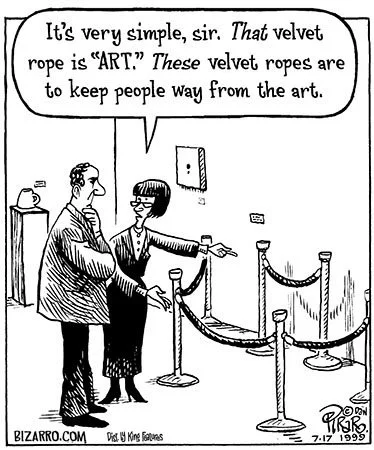
This is a good rule of thumb when visiting museums and galleries.
As a teenage freshman in art school, I was both shocked that there were people who could sit naked in front of a roomful of strangers without blushing and disappointed that none of them was attractive. I quit school after one semester, but at least I got this cartoon from the experience.
Cartoons are more likely to be found on refrigerators than in museums. I’ve often thought that kitchens are cartoonists’ Louvre.
This has long been one of my favorite comics of my career. The idea was suggested by Phil Witte, a fine cartoonist in his own right. (Cartoons, Articles) I enjoyed drawing this cartoon version of Renaissance Mike’s masterpiece, though I’ve no idea if his mother would like it. I gave up acid a few years ago.
Where Does That Leave AI Art?
Machines have taken away menial chores such as laundry, math, research, and so much more. Now, AI can handle our creative efforts in the fields of writing, drawing, painting, music, design, you name it.
Which returns us to the concept of “calculated” versus “inspired” art. AI can calculate, research, and imitate in a matter of seconds, but it cannot be inspired the way a human can.
Allowing creativity to flow through me and give birth to something new is among the most gratifying experiences in life. I’d no sooner allow a machine to take that away from me than I would employ one to have sex for me, take a mushroom trip in my stead, or eat my dessert.
I’ll surrender calculating a tip to a machine, but I’ll never turn my back on the joy of creating, even if only taping a banana to a wall.
And here’s my video inviting you to become a supporter ofPeyote Cowboy.
If you’re enjoying my articles in The Naked Cartoonist, please recommend it to your friends. If you’re not, recommend it to your enemies. Either way, you can send them this link: bizarro.com/signup. Thanks!

 Login
Login